Crossing the Chasm vs The Innovator’s Dilemma
Geoffrey Moore on the gap between early adopters and the mainstream and Clayton Christensen on why successful companies get disrupted: two business classics, compared, with word-pictures of both diagrams and a suggested reading order.
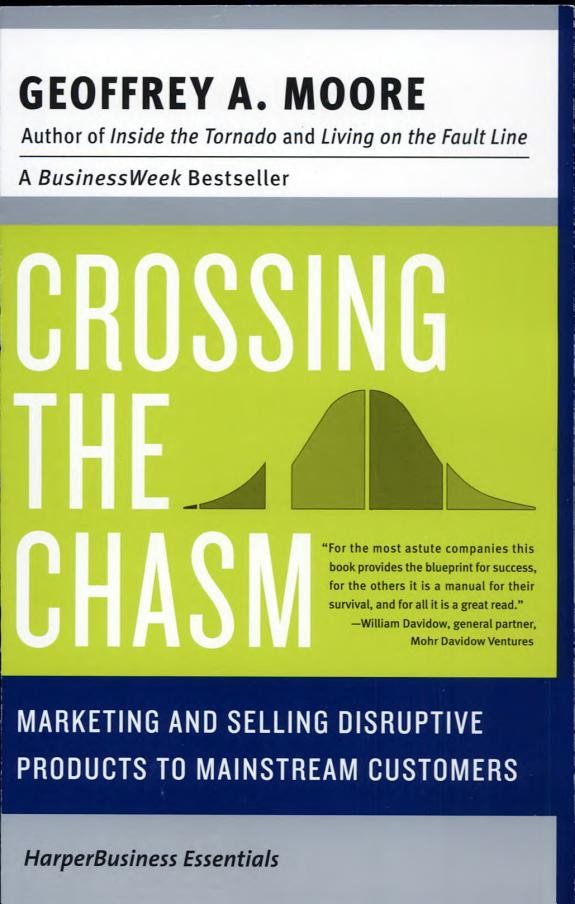
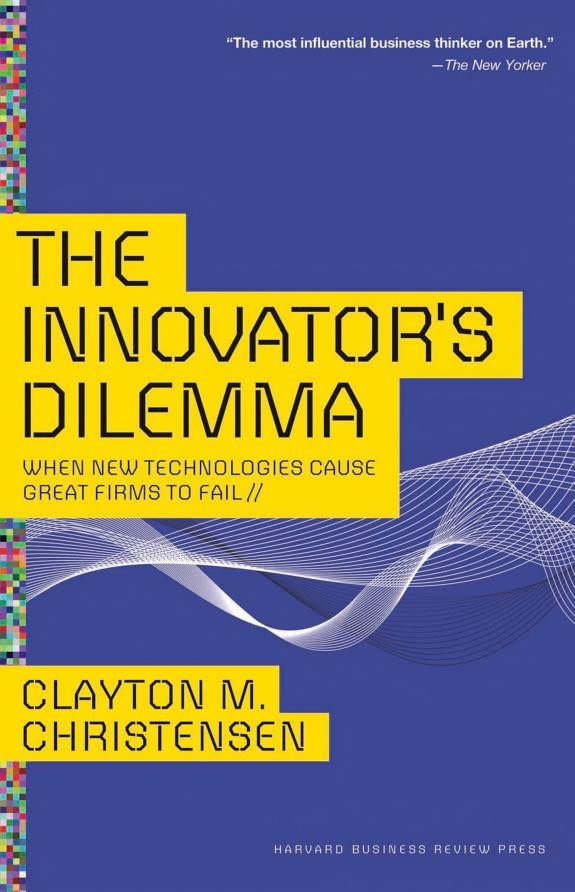
New products rarely follow a straight line from idea to success. Two influential business books look at the journey from different sides. Geoffrey A. Moore’s Crossing the Chasm asks how a young company with a promising technology can move from enthusiastic early customers to the wider mainstream. Clayton M. Christensen’s The Innovator’s Dilemma asks a different question: why do well-run, successful companies sometimes lose ground to newcomers with simpler, cheaper products? They are often recommended together, and they sit well together for anyone interested in how markets change.
This guide looks at what each book offers, how they fit together and which might suit you best. We will also describe, in words, the two diagrams most associated with these books, and point to a few of our other Book Club guides that connect with the same themes.
Crossing the Chasm is about getting started well: it describes a gap, or “chasm”, between the early adopters of a new technology and the more practical mainstream, and suggests focusing on a single niche to cross it. The Innovator’s Dilemma is about defending well: it explores why established companies, by doing what seems sensible, can leave room for disruptive newcomers. Many readers find Crossing the Chasm a useful guide for go-to-market thinking and The Innovator’s Dilemma a thoughtful lens for strategy. Both are rich in ideas, and both are worth reading with your own market in mind.
The two books side by side
| Crossing the Chasm | The Innovator’s Dilemma | |
|---|---|---|
| Author | Geoffrey A. Moore, a consultant and author on technology markets | Clayton M. Christensen (1952–2020), a professor at Harvard Business School |
| First published | 1991, with later revised editions | 1997 |
| Core idea | New technologies face a gap between early adopters and the early majority, and crossing it takes focus | Successful companies can be overtaken by disruptive innovations that start small, simple and affordable |
| Signature ideas | The technology adoption life cycle, the chasm, a niche “beachhead”, the whole product | Sustaining versus disruptive innovation, the pull of existing customers, new markets from below |
| Focus | Launching and marketing a technology product to the mainstream | Why leading companies are challenged, and what they might do |
| Perspective | A growing company reaching a wider market | An established company watching for change |
| Best for | Founders, product and marketing teams | Strategists, executives and anyone studying how industries change |
| Reading experience | Practical and marketing-minded, with clear frameworks | Research-led, built around detailed industry case studies |
What they share
- A focus on technology markets. Both grew out of watching how new technologies reach customers.
- Customers at the centre. Each asks who the customer is, and what they need.
- Useful frameworks. Both give readers diagrams and models to think with.
- Lasting influence. Phrases from both, such as “crossing the chasm” and “disruptive innovation”, are now part of everyday business conversation.
Crossing the Chasm: the gap between early adopters and the mainstream
Geoffrey A. Moore published Crossing the Chasm in 1991, and revised it in later editions. It builds on the idea of a technology adoption life cycle, in which customers adopt new products at different times: a few enthusiasts first, then visionaries, then the more pragmatic majority, and eventually the more cautious. Moore’s key observation is that the step between the early adopters and the early majority is not a smooth one, and that many promising products find it a demanding stage.
The adoption curve in words. Picture a bell-shaped curve drawn from left to right. The leftmost slice is a small group of technology enthusiasts, followed by a slightly larger slice of visionary early adopters. Then comes a narrow gap in the curve, the chasm, before the two large slices in the middle and on the right, the early and late majority, followed by a final small slice of sceptics. The chasm sits between the early adopters and the early majority, because the two groups want different things: visionaries are happy to try something new, while pragmatists want proven solutions and references from people like themselves.
Some of the key ideas:
- The chasm. Success with early adopters does not automatically lead to success with the mainstream.
- A beachhead. Moore suggests focusing on one specific niche, chosen carefully, as a place to do well, in the way that an army might secure one landing point before moving inland.
- The whole product. Pragmatic customers want a complete solution, including the services and support around the core product.
- Word of mouth within a niche. Success in one segment can build references that help the next.
Many readers enjoy the book for its clear, practical thinking about launching products, and it is widely used by startup and product teams.
Choose one product or project you are working on, and write down who your most enthusiastic users are and who the more cautious mainstream users would be. Then name one specific niche you could serve completely, and list what a “whole product” for that group would need. Share the page with a colleague and compare views at the end of the month.
The Innovator’s Dilemma: why good companies can be disrupted
Clayton M. Christensen was a professor at Harvard Business School, and The Innovator’s Dilemma was published in 1997. His research, which draws heavily on the disk-drive industry as a case study, asked why companies that were well managed and attentive to their customers could still lose their leading positions when markets changed.
The disruption curve in words. Picture a graph with time along the bottom and performance up the side. One line rises steadily: this is the performance that mainstream customers actually need. A second line, steeper, shows how fast established companies improve their products, often exceeding what most customers need. A third, lower line starts below both, representing a simpler and cheaper newcomer. At first, the newcomer is not good enough for the mainstream, but because it improves quickly, it eventually crosses into the zone that customers find acceptable, at a lower price. By then, the newcomer may have found a firm foothold.
Some of the key ideas:
- Sustaining innovations. Improvements that help established customers, which companies tend to be good at.
- Disruptive innovations. Simpler, often cheaper offerings that begin by serving overlooked customers or new markets.
- The pull of existing customers. Listening to current customers is usually wise, yet it can lead firms to give less attention to small, emerging markets.
- Possible responses. Christensen suggests, for example, that established firms may create separate units to explore new markets.
Many readers value the book for its research and for the questions it raises about how industries change.
Pick one industry you know and, over the month, write down one small, simpler, cheaper alternative that is gaining ground at the edges. For each, note who is using it today and what they cannot get from the leaders. Revisit the list at the end of the month and see which entries have moved.
A note on the conversations around these ideas
Both books have been widely discussed, and it is helpful to know that people hold a range of views about how far the theories reach. Researchers and writers have discussed which companies count as “disruptive”, how well the model predicts outcomes and how the ideas apply beyond technology. Christensen and his colleagues refined the theory over the years in response. A friendly way to read both books is as useful lenses rather than as laws of nature, and to test their ideas against your own market.
Where the two books feel different
The clearest difference is the viewpoint. Crossing the Chasm takes the view of a company with something new, trying to win customers who are not yet convinced. The Innovator’s Dilemma takes the view of a company that is already successful, wondering what might be coming. One is about breaking in, the other about holding on.
They also differ in style. Crossing the Chasm is practical and marketing-minded, with advice about positioning and focus. The Innovator’s Dilemma is more research-driven, with detailed accounts of industries and a clear line of argument that builds across the chapters. Many readers find them complementary: the first helps a newcomer reach the mainstream, and the second explains why established firms may find it challenging to respond to that newcomer.
Which one suits which situation?
Here is a gentle guide, based on what each book emphasises. Treat it as a starting point rather than a rulebook:
| Your situation | Where to start | Why |
|---|---|---|
| You are launching a technology product or service | Crossing the Chasm | It is built around reaching the mainstream market |
| You work in an established company and want to think about strategy | The Innovator’s Dilemma | It explores why leaders can be challenged |
| You work in marketing or sales for a new product | Crossing the Chasm | Its niche and whole-product ideas are practical |
| You are curious about how industries change over time | The Innovator’s Dilemma | It is rich in industry case studies |
| You would like both the launch view and the strategy view | Both | Together they cover breaking in and holding on |
If you enjoyed these ideas
A handful of our other Book Club guides connect closely with the ideas in these two books:
- Building something new. Starting small and learning from customers is at the heart of our guide to Zero to One and The Lean Startup.
- Staying great. How established companies keep their edge is explored in our guide to Good to Great and Built to Last.
- Leading through change. The realities of running a company through hard decisions appear in our guide to The Hard Thing About Hard Things and High Output Management.
- Thriving with uncertainty. The idea of benefiting from change and shocks is explored in our guide to The Black Swan and Antifragile.
- Strategy and positioning. Choosing where to focus is a classic theme in our guide to The Art of War and The Prince.
You can find all of these, and more as we add them, on our CROWNLEIGH Book Club page.
Our suggested reading order
If you are launching something new, we would suggest starting with Crossing the Chasm. It gives you a clear picture of the adoption journey and a practical focus for your first customers. Then read The Innovator’s Dilemma to understand how the wider market may respond over time. If you work in an established organisation and are thinking about strategy, it works nicely the other way round: begin with The Innovator’s Dilemma for the view from the top, and follow with Crossing the Chasm for a closer look at how newcomers win their first customers.
Frequently asked questions
Should I read Crossing the Chasm or The Innovator’s Dilemma first?
If you are bringing a product to market, Crossing the Chasm is a lovely first read. If you are thinking about strategy in an established organisation, The Innovator’s Dilemma is a natural place to begin. Many readers enjoy either order.
What is the difference between the chasm and disruptive innovation?
The chasm describes the gap between early adopters and the mainstream market, which a new product must cross to grow. Disruptive innovation describes how a simpler, cheaper offering can begin at the edges of a market and, over time, challenge established leaders. The first is about how a newcomer wins its customers, and the second about how leaders may be challenged.
Do I need to read both?
Not necessarily. Each stands on its own. Reading both gives you a view of how to launch and a view of how markets change.
Are these books only for technology companies?
Both grew out of technology markets, but many readers apply their ideas to other fields too. It is worth testing each idea against your own situation, because different industries can behave differently.
Can I read Crossing the Chasm and The Innovator’s Dilemma together, and is it worth it?
Yes, and many people enjoy it. A pleasant approach is to read a chapter of one, then a chapter of the other, and try one idea from each over the same month. The 30-day tests above are an easy way to do just that.
A closing thought
Both books carry a gentle message: that markets are always moving, and that paying close attention to customers, timing and focus can help us move with them. Whichever you open first, you may finish with a few new questions to ask about your own market, and a fresh curiosity about how new ideas find their audience.
Book links go to Amazon; see our advertising disclosure.