The Black Swan vs Antifragile
Nassim Nicholas Taleb on understanding rare, high-impact surprises and on building lives and businesses that can gain from disorder: two influential books, compared. Here is what each offers and which to read first.
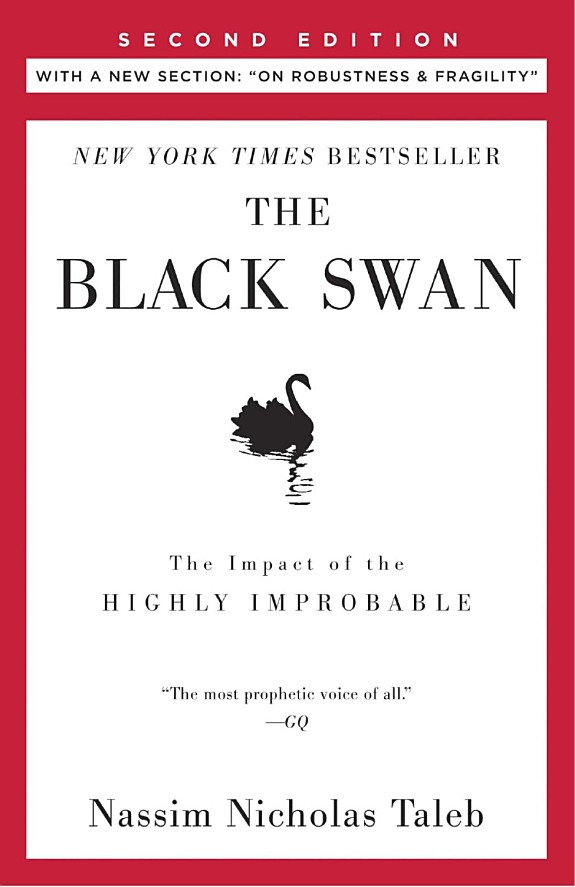
Nassim Nicholas Taleb has been a widely discussed voice on uncertainty. Two of his books, The Black Swan and Antifragile, are widely read works on risk, surprise and resilience, and they are often recommended together. They are part of a wider series Taleb calls the Incerto, and they sit nicely side by side: the first helps you see how uncertain the world can be, and the second invites you to think about how to live well within it.
This guide looks at what each book offers, how they fit together and which might suit you best. We will also try each book’s ideas on three everyday decisions, an insurance question, a career choice and a small business, as general illustrations rather than advice. And we will point to a few of our other Book Club guides that connect with the same themes.
The Black Swan is about understanding uncertainty: it explores rare, high-impact events that few people see coming, and why we so often explain them neatly after the event. Antifragile is about responding to it: it introduces things that gain from disorder, and ideas such as the barbell, optionality and removing what is unnecessary. Many readers find The Black Swan the natural place to begin, and Antifragile a rewarding follow-up that turns the thinking into ways of living and working. Both repay slow, curious reading.
The two books side by side
| The Black Swan | Antifragile | |
|---|---|---|
| Author | Nassim Nicholas Taleb | Nassim Nicholas Taleb |
| First published | 2007, with an expanded edition in 2010 | 2012 |
| Core question | Why do rare, high-impact surprises shape so much, and why do we explain them so neatly afterwards? | How can we build lives, businesses and systems that cope with surprise, or even benefit from it? |
| Signature ideas | Black swans, the narrative fallacy, Mediocristan and Extremistan | Fragile, robust and antifragile, the barbell, optionality, via negativa |
| Spirit | Reflective and questioning | Practical and wide-ranging |
| Best for | Readers who want to understand uncertainty and forecasting | Readers who want ideas for acting under uncertainty |
| Worth knowing | Written with a distinctive, spirited voice that many readers enjoy for its energy | Wide-ranging, moving between finance, health, history and everyday life |
| Reading experience | Stimulating, with ideas that reward a slow read | Stimulating, with many ideas to return to |
What they share
- A distinctive voice. Both books are written with personality and conviction, and they invite readers to join a conversation.
- Humility about prediction. Each encourages readers to be modest about forecasts and open to the unexpected.
- Ideas from many fields. History, finance, philosophy and daily life all appear, which makes the reading varied.
- A practical hope. Both suggest that we are not helpless in the face of uncertainty.
The Black Swan: living with the highly improbable
The Black Swan was first published in 2007. Taleb, an essayist and former options trader, builds the book around a simple image. For centuries, people in Europe assumed all swans were white, until a black swan was seen in Australia. Taleb uses the idea of a “black swan” for an event with three features: it is rare, it has a very large impact and, after it happens, we tend to feel that it was explainable.
A handful of ideas run through the book:
- The narrative fallacy. Our habit of weaving tidy stories around events after the fact, which can make the world feel more predictable than it is.
- Mediocristan and Extremistan. Two imaginary countries that help to separate situations where no single case dominates, like people’s heights, from those where a single case can matter enormously, like book sales or wealth.
- The turkey illustration. A turkey fed every day for a thousand days has good reason to feel secure, right up until the day the routine changes, which is a vivid way of showing the limits of learning only from the past.
- Humility about forecasting. The book encourages readers to ask what a forecast cannot see.
Many readers say that after reading it they notice how often stories about the past sound more certain than the evidence allows. It is a mind-opening idea, and the book delivers it with plenty of energy.
Over the month, each time you read a confident explanation of why something happened, whether in the news, at work or in a conversation, jot down one thing the explanation leaves out. At the end of the month, look back and notice which gaps you found most often.
Antifragile: gaining from disorder
Antifragile, published in 2012, continues the thinking. Taleb coins the word to describe things that do not merely survive shocks, but improve because of them, in the way muscles grow after exercise or in the way an industry learns from small failures.
The book is built around a three-part idea:
- Fragile. Things that are harmed by volatility and surprise.
- Robust. Things that resist shocks and stay much the same.
- Antifragile. Things that gain from shocks, within limits.
Along the way it offers several practical ideas:
- The barbell. Combining a very safe core with a small portion devoted to bold, high-potential experiments, while avoiding the middle.
- Optionality. Keeping choices open, so that you can benefit from good surprises and limit the effect of bad ones.
- Via negativa. Improving by removing what is unhelpful or unnecessary, rather than always adding more.
- Small experiments. Trying things on a modest scale, so that mistakes are affordable and learning is rich.
Many readers enjoy Antifragile as an invitation to look at their own lives and work through a different lens, asking where a little variety and stress might even be helpful.
Choose one area of your life or work and ask the three questions of the book: where am I fragile, where am I robust, and where could I become a little more antifragile? Pick one small, affordable experiment for the month, such as trying a new skill or removing one unnecessary commitment, and note what you learn.
Three everyday illustrations
To make the ideas concrete, here are three general illustrations of how the two books might shape thinking. They are our own examples, offered for reflection rather than as advice, and your circumstances will be different. For decisions about insurance, work or a business, it can be worth seeking guidance suited to your situation.
| Area | A thought from The Black Swan | A thought from Antifragile |
|---|---|---|
| Insurance | Rare, severe events are hard to predict, so it can be worth asking which serious but unlikely events would be hardest to recover from | You might think about where you could be fragile, and about arrangements that limit the damage from a bad surprise while keeping everyday costs manageable |
| Career | Careers rarely follow a neat plan, and chance events often shape them in ways we later describe as inevitable | One way of reading the barbell idea is a steady core alongside small, low-cost experiments such as a course or a side project, so that good surprises have somewhere to land |
| Small business | It can be interesting to notice how much rests on a single prediction, whether about a customer, a supplier or a market | The book’s themes of optionality and small experiments prompt the question of whether options are being kept open, ideas tried cheaply, and too much weight placed on any one source of income or one big bet |
Where the two books feel different
The clearest difference is the direction of travel. The Black Swan looks at how we understand uncertainty, and invites us to be more modest about what we think we know. Antifragile looks at how we respond to uncertainty, and invites us to build in ways that can benefit from the unexpected. One is a way of seeing; the other is a way of acting.
They also differ in range. The Black Swan stays closer to a single big idea, explored from many angles. Antifragile roams across many areas, from health to history to enterprise, and offers a larger toolbox of principles. Readers often enjoy the first for its focus and the second for its breadth.
Which one suits which situation?
Here is a gentle guide, based on what each book emphasises. Treat it as a starting point rather than a rulebook:
| Your situation | Where to start | Why |
|---|---|---|
| You are curious about how surprises shape history and markets | The Black Swan | It is the clearest introduction to rare, high-impact events |
| You want ideas for building resilience | Antifragile | It offers practical principles such as the barbell and optionality |
| You work with forecasts or plans | The Black Swan | It encourages healthy humility about prediction |
| You run a small team or business | Antifragile | Its ideas on small experiments and keeping options open travel well |
| You enjoy wide-ranging, idea-rich reading | Both | Together they cover understanding and action |
Connecting these ideas to other Book Club reads
Uncertainty runs through many of the books we have explored. A few connections you might enjoy:
- Judgement and noise. Our guide to Thinking, Fast and Slow and Noise explores overconfidence and the limits of intuition, close cousins of the narrative fallacy.
- Luck, behaviour and patience. Our guide to The Intelligent Investor and The Psychology of Money shares the idea of leaving a margin of safety and room for error.
- Learning through small tests. The idea of cheap experiments sits beautifully alongside our comparison of Zero to One and The Lean Startup.
- Lasting organisations. Our guide to Good to Great and Built to Last looks at how organisations stay strong over decades, and at how their stories have unfolded since.
- Building wealth over time. Our guide to Rich Dad Poor Dad and The Millionaire Next Door looks at long-term money habits in a very different style.
- Routines that build resilience. Our guide to Atomic Habits and The Power of Habit shows how small, repeated steps can add up.
- Fortune and strategy. Machiavelli’s reflections on fortune in our guide to The 48 Laws of Power and The Prince, and the adaptable thinking in The Art of War and The Prince and The 48 Laws of Power and The 33 Strategies of War, offer a historical view of preparing for surprise.
- Why tidy stories appeal. Our comparison of The 48 Laws of Power and The Laws of Human Nature explores the tendencies that make a neat story so appealing.
- Talking about risk. Our guides to Never Split the Difference and Getting to Yes, Influence and Pre-Suasion and How to Win Friends and Influence People and How to Talk to Anyone offer warm, practical ways to discuss uncertain decisions with other people.
You can find all of these, and more as we add them, on our CROWNLEIGH Book Club page.
Our suggested reading order
If you are new to Taleb, we would suggest starting with The Black Swan. It lays the foundations, and it makes the ideas in Antifragile richer when you meet them. If you already have a sense of uncertainty and want practical principles, it works beautifully to begin with Antifragile and return to The Black Swan afterwards for the deeper picture. Whichever you choose, both are books to read slowly, pencil in hand.
Frequently asked questions
Should I read The Black Swan or Antifragile first?
Many readers find The Black Swan a natural first step, because it sets out the ideas about uncertainty that Antifragile builds on. If you are mostly interested in practical principles, starting with Antifragile is perfectly reasonable.
Should I read The Black Swan before Antifragile?
You do not have to. Antifragile explains its ideas clearly and stands on its own. That said, reading The Black Swan first gives some helpful background, so many readers enjoy that order.
Do I need to read both?
Not at all. Each stands on its own. Reading both simply gives you a way of seeing uncertainty and a way of responding to it.
Are these books easy to read?
They are written for the general reader, with plenty of stories and examples. They are idea-rich and written in a distinctive voice, so many readers enjoy them in small portions and come back for more.
Can I read The Black Swan and Antifragile together, and is it worth it?
Yes, and many people enjoy it. A pleasant approach is to read a chapter of one, then a chapter of the other, and try one idea from each over the same month. The 30-day tests above are an easy way to do just that.
A closing thought
It is oddly comforting to be reminded that the world is less predictable than our stories suggest, especially when the same writer also offers ways to meet that uncertainty with curiosity. Whichever book you open first, you are likely to finish with a looser grip on your forecasts, a few small experiments to try and a warmer, more adventurous view of the unexpected.
Book links go to Amazon; see our advertising disclosure.