Thinking, Fast and Slow vs Noise
Daniel Kahneman’s classic on how our minds work and the follow-up on why judgements vary: two books on decision-making, compared. Here is what each offers, who each suits and which to read first.
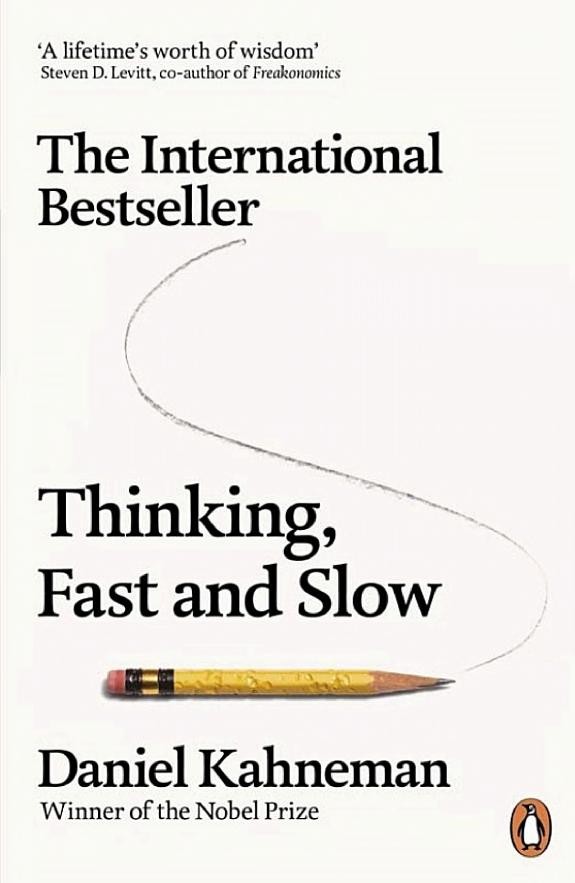
Daniel Kahneman’s Thinking, Fast and Slow is one of the most widely read books about how we think. Its follow-up in spirit, Noise, written with Olivier Sibony and Cass R. Sunstein, looks at a different and rather surprising question: why do people who are meant to make the same decision so often reach different ones? They share an author, a curiosity about human judgement and a gift for making research feel like a good story. Yet they ask quite different questions.
This guide looks at what each book offers, how they fit together and which might suit you, your team or your business. We’ll also walk through a simple “noise audit” that a small company could try, and point to a few of our other Book Club guides that connect with the same themes.
Thinking, Fast and Slow is about the mind’s shortcuts and biases, and what they mean for the choices we make as individuals. Noise is about unwanted variability in judgements: the scatter that appears when different people, or the same person on different days, look at the same case and reach different conclusions. If you’d like to understand your own thinking, many readers start with Thinking, Fast and Slow; if you’d like to improve how decisions are made across a team or organisation, Noise is a natural fit. Together they make a wonderfully complete pair.
The two books side by side
| Thinking, Fast and Slow | Noise | |
|---|---|---|
| Authors | Daniel Kahneman | Daniel Kahneman, Olivier Sibony and Cass R. Sunstein |
| First published | 2011 | 2021 |
| Core question | How do the quick and slow ways our minds work shape our judgements and choices? | Why do judgements that should match often vary, and what can organisations do about it? |
| Key ideas | Two modes of thinking, heuristics and biases, anchoring, loss aversion, overconfidence | Bias versus noise, system noise, the noise audit, “decision hygiene” |
| Scope | Mostly individual decisions and how our minds work | Judgements made inside organisations, such as hiring, forecasting, pricing and sentencing |
| Best for | Readers who want to understand their own thinking | Managers, founders and teams who want more consistent decisions |
| Worth knowing | A generous, wide-ranging book that rewards being read in portions | Combines stories with more data and numbers, so some chapters reward a slower read |
| Difficulty | Easy to read, with some ideas that deepen on each read | Easy to read, with a little more statistics |
What they share
- A fascination with human judgement. Both books are about how people reach conclusions, and why those conclusions are not always what we expect.
- Everyday examples. Both rely on clear, relatable scenarios, so the ideas stay in your mind long after you have put the book down.
- Kindness towards the reader. Neither book suggests that anyone is foolish. They treat these tendencies as part of being human.
- A practical streak. Both end up offering ideas that you can try, whether that is slowing down before a big decision or structuring how a team assesses candidates.
Thinking, Fast and Slow: how our minds really work
Thinking, Fast and Slow was published in 2011 and draws on decades of research by Daniel Kahneman, who received the Nobel Memorial Prize in Economic Sciences in 2002 (shared with Vernon Smith) for work, much of it carried out with Amos Tversky. The book’s central framework is a pair of characters. System 1 is fast, automatic and intuitive. System 2 is slower, more deliberate and more effortful. Much of the book explores how they work together and how they sometimes steer us in unexpected directions.
Along the way, it introduces a wonderful collection of ideas:
- Heuristics. Mental shortcuts that usually serve us well, but can sometimes lead to predictable slips.
- Anchoring. How an initial number or suggestion can quietly shape the figures we choose afterwards.
- Loss aversion. The tendency to feel a loss more strongly than an equivalent gain.
- Overconfidence. How easily we feel sure of our own judgements, and why a little humility can be helpful.
- “What you see is all there is.” The way our minds build a coherent story from the information in front of us, without always noticing what is missing.
Many readers say the book changes how they notice their own thinking. It does not promise to remove these tendencies; rather, it gives them names, which makes them easier to spot and to smile at.
For a month, choose one decision a week, such as a purchase, a plan or a price, and write down your first instinct before you look at any detail. Then take a few minutes to consider the numbers and the alternatives, and note whether your first view changed. It is a gentle way of getting to know your own System 1 and System 2.
Noise: the scatter in our judgements
Noise, published in 2021, builds on the same subject but turns the spotlight on a different kind of error. The authors distinguish two things. Bias is a systematic tendency to err in a particular direction. Noise is random scatter: unwanted variability in judgements that should be alike.
A simple picture helps. Imagine four teams shooting at a target:
| Low noise (shots close together) | High noise (shots spread out) | |
|---|---|---|
| Low bias (centred on the bullseye) | Accurate and consistent: shots cluster on the bullseye | Accurate on average, but scattered: the average is right, though few individual shots are |
| High bias (centred away from the bullseye) | Consistent but off-target: shots cluster, though not on the bullseye | Off-target and scattered: shots are spread out and the average is off-centre too |
The point the authors make is that we tend to talk a great deal about bias and rather less about noise, even though both can affect the quality of decisions. The book looks at how much variability can appear when professionals such as underwriters, doctors, judges and recruiters assess the same case, and why that matters for fairness and for results.
It also offers a positive, practical response. The authors describe a noise audit, in which people in an organisation judge the same cases independently so that the variation can be seen. They also set out a set of habits they call decision hygiene, a way of structuring how judgements are made so that they are more consistent. Among the ideas are making judgements independently before comparing them, breaking a decision into separate assessments and combining several views.
Choose one recurring judgement in your work, such as how you score candidates or how you quote for a job. For the month, break it into three or four separate criteria and rate each one on its own before forming an overall view. Notice whether your overall judgement feels steadier from one week to the next.
Where the two books feel different
The clearest difference is the lens. Thinking, Fast and Slow looks inside the mind of an individual and asks how our thinking works. Noise looks across a group of people and asks how much their judgements vary. One is a book about the way we think; the other is a book about how to organise the way we decide.
They also feel different to read. Thinking, Fast and Slow is expansive, moving from one fascinating study to the next. Noise has a tighter practical goal, so it spends more time on data, cases and what to do about them. Both are a pleasure in their own way; each suits a different mood and a different question.
A noise audit for a ten-person company
One of the nicest things about Noise is that its main idea can be tried on a small scale. Here is a simple walk-through that a team of around ten could adapt. It is our own gentle adaptation of the book’s idea, offered as a starting point:
- Choose a recurring judgement. Good examples are pricing a standard job, scoring job applicants or estimating how long a project will take.
- Prepare three or four realistic cases. Use real, anonymised examples that your team has seen before.
- Ask each person to respond independently. Everyone gives their own price, score or estimate without discussing it first.
- Compare the answers. Look at how far apart they are. A wide spread is a useful signal, not a criticism of anyone.
- Talk about the differences. Ask what each person was paying attention to. Often a shared checklist or set of criteria emerges naturally.
- Try a simple fix and repeat. Agree a few criteria, ask people to rate them separately, and run the exercise again in a few months to see whether the spread has narrowed.
Connecting these ideas to other Book Club reads
Judgement and decision-making run through many of the books we have looked at. A few connections you might enjoy:
- Anchoring in the negotiating room. The idea of anchoring pairs well with our guide to Never Split the Difference and Getting to Yes, where preparation and objective criteria help keep conversations steady.
- Why our minds work as they do. Our comparison of The 48 Laws of Power and The Laws of Human Nature explores tendencies such as irrationality, which sits beautifully alongside Kahneman’s work.
- Turning insight into routine. Decision hygiene is, at heart, a set of habits, so our guide to Atomic Habits and The Power of Habit is a natural companion.
- Knowing yourself and your situation. The emphasis on self-knowledge in The Art of War and The Prince echoes Kahneman’s reminder that confidence is not the same as accuracy.
- Planning with a clear head. Our guide to The 48 Laws of Power and The 33 Strategies of War looks at strategy, where clear thinking under pressure is at a premium.
- Luck and judgement. Machiavelli’s thoughts on fortune in our guide to The 48 Laws of Power and The Prince offer a historical echo of the question of how much outcomes reflect skill and how much circumstance.
You can find all of these, and more as we add them, on our CROWNLEIGH Book Club page.
Our suggested reading order
If you are new to the subject, we’d suggest starting with Thinking, Fast and Slow. It builds a friendly foundation of ideas such as anchoring and overconfidence, and it makes the arguments in Noise even richer when you meet them. If you already have a team or business and want practical tools for more consistent decisions, it works beautifully to begin with Noise and come back to Kahneman’s earlier book afterwards for the wider story of how our minds work.
Frequently asked questions
Should I read Thinking, Fast and Slow or Noise first?
Most readers find Thinking, Fast and Slow a welcoming place to start, because it introduces the ideas behind a lot of modern thinking about decisions. If your main interest is how organisations can make steadier decisions, Noise is a lovely first read too.
What is the difference between bias and noise in decision-making?
Bias is a consistent tendency to err in one direction, such as always guessing a little too high. Noise is scatter: judgements that vary from one person, or one day, to the next even though the case is the same. The target picture above shows how a set of decisions can be affected by one, the other or both.
Do I need to read the first book to enjoy the second?
Not at all. Noise explains its ideas clearly and stands on its own, although readers who know Thinking, Fast and Slow will recognise some of the themes.
Which is more useful for a small business?
Each helps in a different way. Thinking, Fast and Slow helps you recognise your own tendencies as a decision-maker, while Noise gives your team a practical way to compare and steady its judgements. Many small teams enjoy using ideas from both.
Can I read Thinking, Fast and Slow and Noise together, and is it worth it?
Yes, and many people enjoy it. You might read a chapter of one, then a chapter of the other, and try the 30-day tests above side by side. The noise audit walk-through is a pleasant way to put the second book to work with colleagues.
A closing thought
Taken together, these two books offer a gentle, encouraging message: our judgements are shaped by our minds in ways we can learn to notice, and good habits and good structure can make them steadier. Whether you begin with the story of the two systems or the picture of the scattered shots, you are likely to finish with a few small experiments to try and a kinder, more curious view of how decisions get made.
Book links go to Amazon; see our advertising disclosure.